
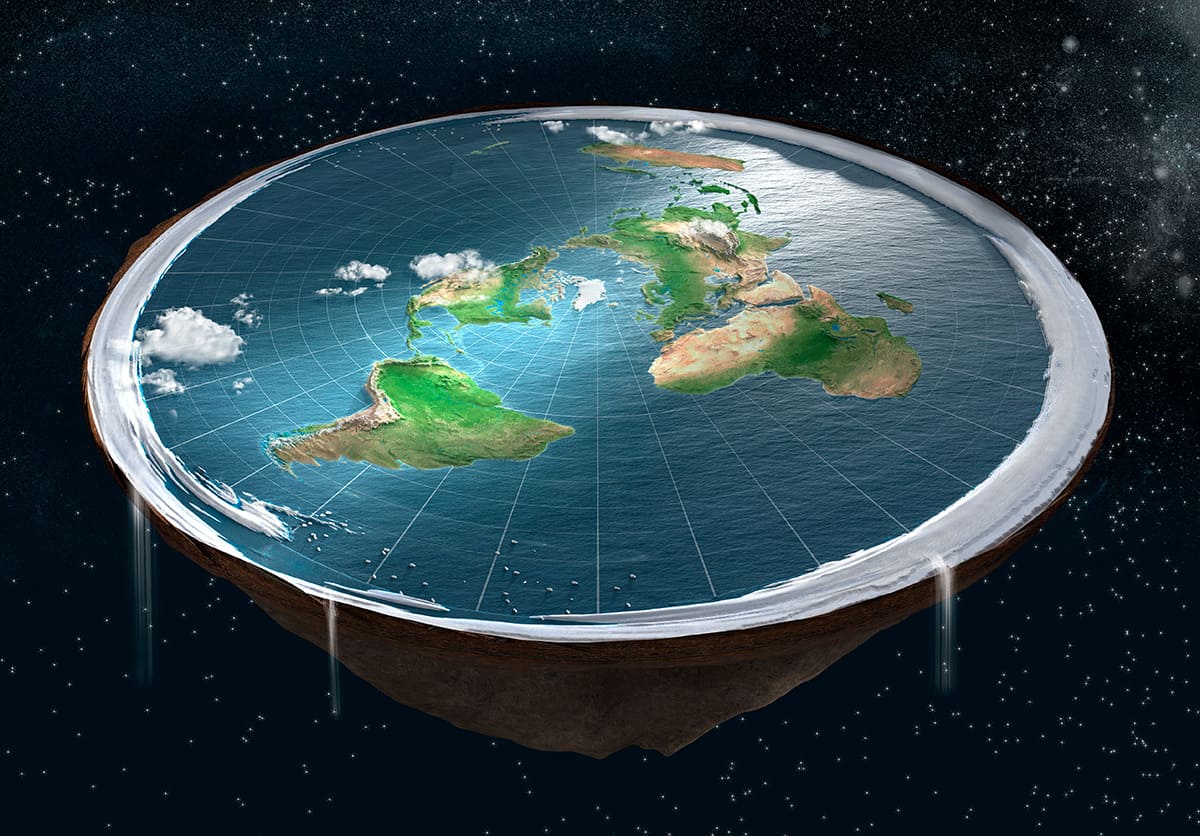
What This Theory Claims
- The modern flat-earth movement asserts that the Earth is a stationary disc rather than an oblate spheroid, that Antarctica forms an ice wall around its rim, and that a solid dome (the “firmament”) encloses the atmosphere overhead.
- The contemporary version traces to Samuel Birley Rowbotham’s 1849 pamphlet Zetetic Astronomy: Earth Not a Globe and was revived in the mid-2010s primarily through YouTube channels, social media communities, and annual conferences such as the Flat Earth International Conference.
- A 2019 study by Asheley Landrum at Texas Tech University found that the majority of flat-earth believers she interviewed at a conference first encountered the idea through YouTube’s recommendation algorithm, not through independent research.
- Surveys vary widely, but a 2018 YouGov poll found that approximately two percent of Americans firmly believed in a flat Earth with another five percent uncertain, a 2022 University of New Hampshire survey placed agreement with the claim at roughly ten percent, and a French Ifop study reported that one in six young people aged 11 to 24 entertained the idea.
- A peer-reviewed 2025 study published in PLOS ONE, based on interviews with former conspiracy theorists, identified loneliness, significant life events, scientific illiteracy, and the community-building power of online echo chambers as the primary drivers of entry into flat-earth belief.
- The Catholic Church has never taught a flat Earth; the Venerable Bede affirmed the planet’s spherical shape in the eighth century, Saint Thomas Aquinas assumed it in the thirteenth, and the Catechism teaches that honest scientific research “can never conflict with the faith” (CCC 159).
A Nineteenth-Century Seed and a Twenty-First-Century Harvest
The flat-earth idea in its modern form did not materialize from ancient ignorance. It was planted in the 1830s and 1840s by a single Englishman with a talent for public argument. Samuel Birley Rowbotham, writing as “Parallax,” conducted his Bedford Level experiment on a straight, six-mile stretch of canal in the Cambridgeshire Fenlands. He claimed that a boat remained fully visible at a distance where the curvature of the Earth should have hidden its hull. He turned this claim into a lecture tour, a pamphlet, and eventually a full book. When the naturalist Alfred Russel Wallace repeated the experiment in 1870 under controlled conditions and demonstrated measurable curvature, Rowbotham’s follower John Hampden refused the result and spent years harassing Wallace through the courts and the post.
Rowbotham died in 1884, and his movement shrank to a handful of devotees. The Universal Zetetic Society he inspired gave way in 1956 to the Flat Earth Society, founded by Samuel Shenton in England and later maintained by Charles K. Johnson in California until his death in 2001. For most of the twentieth century, flat-earth belief was a curiosity, a footnote in histories of pseudoscience that generated more amusement than alarm. The membership of Johnson’s Flat Earth Society peaked at roughly 3,500 in the early 1990s, a figure too small to sustain any meaningful cultural influence.
Then came the internet. And specifically, YouTube.
The YouTube Pipeline
The pivotal research on this topic was conducted by Asheley Landrum, then an assistant professor of science communication at Texas Tech University. In 2017 and 2018, Landrum and her colleagues attended Flat Earth International Conferences and interviewed attendees about how they came to hold their beliefs. The finding was striking. The vast majority of the flat-earth believers she interviewed reported that they had first encountered the idea through YouTube videos. They had not gone looking for flat-earth content. Instead, YouTube’s recommendation algorithm had served it to them after they watched videos on other conspiracy-adjacent topics, such as the September 11 attacks, the moon-landing hoax theory, or critiques of government institutions. One video led to another, and within weeks or months, viewers who had never previously questioned the shape of the planet found themselves persuaded that they had been lied to their entire lives.
Landrum presented her findings at the 2019 meeting of the American Association for the Advancement of Science. The Guardian, the BBC, CNET, and numerous other outlets reported on the study, and the phrase “YouTube rabbit hole” entered the public vocabulary as a descriptor for how recommendation algorithms could steer users from mainstream content toward increasingly extreme claims. YouTube responded by announcing changes to its recommendation system intended to reduce the promotion of “borderline content,” including flat-earth material. Whether those changes were sufficient remains debated, but the pattern Landrum identified has been confirmed by subsequent research, including a 2025 PLOS ONE study that found former conspiracy theorists explicitly described YouTube’s algorithm as a key factor in their radicalization.
The mechanism is not difficult to understand. YouTube’s algorithm, like those of most social media platforms, is designed to maximize engagement. Content that provokes strong emotional reactions, whether fascination, outrage, or a sense of secret knowledge, tends to generate longer watch times and more clicks than content that is accurate but unremarkable. A calm, correctly produced educational video explaining atmospheric refraction is algorithmically disadvantaged against a dramatic, emotionally charged video claiming to “expose” a global deception. The algorithm does not evaluate truth. It evaluates attention.
Beyond YouTube
Although YouTube was the primary incubator, the flat-earth movement has expanded onto virtually every major social media platform. Facebook groups dedicated to flat-earth discussion accumulated hundreds of thousands of members in the mid-to-late 2010s. Instagram and TikTok brought the message to younger audiences through short-form video, memes, and visual rhetoric that require no scientific literacy to consume. The hashtag “flatearth” has accumulated over 300,000 posts on TikTok alone. Reddit hosts both flat-earth advocacy communities and large debunking communities, the latter of which often inadvertently amplify the very claims they aim to refute by keeping them in the public conversation.
Celebrity endorsements, however minor, amplified the signal dramatically. In 2016, the rapper B.o.B. engaged in a public dispute with astrophysicist Neil deGrasse Tyson on Twitter, insisting that the horizon appeared flat and that cities that should be hidden by curvature were visible in photographs. In 2017, NBA player Kyrie Irving stated on a podcast that he believed the Earth was flat, prompting national media coverage and a wave of interest from younger fans. Irving later said his comments were intended to encourage independent thinking, but the damage was measurable. A 2018 YouGov survey found that only 66 percent of American millennials said they had “always believed the world is round.” While some of the remaining respondents were likely being flippant, the figure was widely reported and reflected a genuine softening of certainty among younger adults.
The Anatomy of Belief
The 2025 PLOS ONE study, conducted by researchers at Manchester Metropolitan University, provides the most detailed qualitative portrait to date of how individuals enter and exit flat-earth and related conspiracy communities. The researchers interviewed four former conspiracy theorists at length, using reflective thematic analysis to identify patterns in their experiences. The findings organize into four themes that merit attention.
The first theme is the gateway into the echo chamber. Every participant described a period of personal vulnerability, such as a bereavement, a divorce, a job loss, or acute loneliness, that coincided with their initial exposure to conspiracy content. These life events created emotional openings that the community was well positioned to fill. One participant described realizing, in retrospect, that “fundamentally, they’re lonely. I was lonely as well.” Free time combined with emotional pain produced extended hours on YouTube, and the algorithm responded by serving more of what held their attention.
The second theme is scientific illiteracy. Participants acknowledged, often with embarrassment, that they lacked the educational background to evaluate the claims they encountered. They could not distinguish a peer-reviewed journal article from a blog post dressed in scientific language. The community’s mantra, “Do your own research,” meant in practice “watch more YouTube videos.” One participant noted that many flat-earth believers he knew had “never read a book in their whole entire life.” The absence of scientific literacy left them unable to recognize cherry-picked data, misrepresented citations, or basic physical impossibilities.
The third theme is the power of the conspiracy community. Once inside, participants found something many of them had been missing: belonging. The community provided identity, purpose, camaraderie, and a shared sense of moral significance. Members policed the boundaries of acceptable thought, praised those who produced or shared content, and ostracized anyone who expressed doubt. Leaving the community meant losing friends, facing accusations of being a “shill” or a government agent, and returning to the loneliness that had driven them there in the first place.
The fourth theme is the difficulty of escape. Every participant described the exit as prolonged and painful. The triggers for doubt varied: one encountered a debunking video that was calm and methodical rather than mocking; another accessed a genuine scientific journal and realized for the first time how different actual research was from what the community presented. All noted that ridicule from debunkers had been counterproductive. Being laughed at did not make them reconsider. It made them defensive and drove them deeper into the community. What worked was respectful, non-confrontational engagement that addressed their specific questions without condescension.
The Trust Deficit
The growth of flat-earth belief cannot be understood apart from the broader erosion of public trust in institutions. Pew Research Center surveys tracking American confidence in scientists found a significant decline during and after the COVID-19 pandemic, dropping from 87 percent expressing a great deal or fair amount of confidence in 2020 to 73 percent by late 2023. The figure recovered modestly to 76 percent in 2024, but the partisan gap widened dramatically: confidence among Republicans fell from 85 percent in 2020 to approximately 66 percent in 2024, while Democratic confidence remained above 90 percent. A separate study from the Compass journal reported that by mid-2025, only 8 percent of American adults reported “a great deal” of trust in science as an institution.
This erosion has nothing specifically to do with the shape of the Earth. But flat-earth belief does not arise in a vacuum. It flourishes in environments where institutional credibility has been damaged, where people feel alienated from the systems that claim authority over knowledge, and where alternative communities offer both answers and acceptance. When a person already distrusts the government, mainstream media, and the scientific establishment, the step from “these institutions sometimes mislead us” to “these institutions are lying about the fundamental nature of reality” becomes psychologically shorter than it might appear from the outside.
A 2024 Ifop study in France found that approximately one in six young people aged 11 to 24 entertained flat-earth beliefs. The figure was highest among those with the lowest educational attainment and the highest social media consumption. The researchers connected the finding to a broader pattern of science denial among adolescents and young adults who receive a disproportionate share of their information from algorithmically curated short-form video content rather than from structured educational environments.
The Final Experiment and Its Aftermath
The most revealing episode in recent flat-earth history occurred in December 2024, when a group of prominent flat-earth content creators traveled to Antarctica as part of an expedition organized by Will Duffy, a Christian pastor from Colorado. The trip, called “The Final Experiment,” was designed to settle a specific question: Does the Sun remain above the horizon for 24 continuous hours during the Antarctic summer? On every flat-earth map, in which Antarctica is the outer rim of a disc, the Sun circles above the Northern Hemisphere and cannot possibly remain visible around the clock at southern polar latitudes.
The expedition arrived at Union Glacier Camp at approximately 79 degrees south. The participants livestreamed the sky via Starlink for several days. The Sun did not set. Jeran Campanella, one of the most influential flat-earth YouTubers, admitted on camera that his model was no longer valid and told The Denver Post he intended to step away from the flat-earth community. Fellow content creator Austin Whitsitt acknowledged he had been wrong about the midnight sun, though he hedged on whether the broader flat-earth framework could survive the observation.
The reaction from the wider flat-earth community was swift and revealing. Rather than accept the testimony of their own trusted figures, many prominent voices accused the expedition members of fabricating the footage. An Alabama pastor suggested that Satan had created a false fireball in the sky to deceive the observers. Others claimed the entire trip was staged in a dome studio. The episode demonstrated, with painful clarity, that the flat-earth movement is not primarily a dispute about evidence. It is a community of identity, and identity does not yield to a livestream.
The Catholic Intellectual Tradition
It is worth stating plainly that the flat-earth theory has never been a Catholic teaching. The popular myth that medieval Christians believed in a flat Earth was debunked by historian Jeffrey Burton Russell in his 1991 book Inventing the Flat Earth, which traced the myth largely to Washington Irving’s fictionalized biography of Columbus and to nineteenth-century polemicists who wished to depict the Church as an enemy of science.
The historical record tells a different story. The Venerable Bede, writing De Natura Rerum around 703 AD, described the Earth as resembling “a ball, being equally round in all directions.” Saint Thomas Aquinas assumed the spherical Earth without controversy throughout his works. Medieval European iconography frequently depicted Christ or Christian rulers holding a globus cruciger, a cross-topped sphere representing dominion over a round planet. The Catholic intellectual tradition, far from resisting the spherical Earth, helped preserve and transmit that knowledge through the early medieval period.
The Church’s formal teaching on the relationship between faith and science is clear and consistent. The Catechism affirms that “methodical research in all branches of knowledge, provided it is carried out in a truly scientific manner and does not override moral laws, can never conflict with the faith, because the things of the world and the things of faith derive from the same God” (CCC 159). Pope Leo XIII insisted in Providentissimus Deus that “truth cannot contradict truth.” Pope John Paul II reaffirmed in Fides et Ratio that faith and reason are “like two wings on which the human spirit rises to the contemplation of truth.” The Catechism further teaches that the sacred authors of Genesis used “the literary forms” of their time to convey theological truths about creation, not to provide a blueprint of physical cosmology (CCC 289, 110).
The flat-earth movement’s claim that it is defending biblical faith against scientific deception finds no support in Catholic theology. The Church has never asked its members to reject what their eyes, their instruments, and their reason confirm. It has asked them to use those gifts honestly and to recognize that the God who created the world is also the God who gave human beings the intelligence to understand it.
What the Digital Landscape Reveals
The growth of flat-earth belief in the digital age is not primarily a story about the shape of the Earth. The shape of the Earth was settled by Eratosthenes in the third century before Christ, confirmed by every circumnavigation since Magellan’s crew completed theirs in 1522, and verified daily by GPS satellites, weather imaging, airline navigation, and the testimony of astronauts from dozens of nations. No serious scientific dispute exists. The flat-earth movement’s growth is instead a story about loneliness, about the collapse of trust in institutions, about algorithms that reward emotional engagement over accuracy, about communities that offer belonging to people who feel excluded, and about a style of biblical interpretation that mistakes ancient cosmological language for modern scientific claims.
The research is consistent on what does not work. Mockery does not work. Contempt does not work. Presenting evidence in a condescending tone does not work. Former flat-earth believers consistently report that being laughed at pushed them deeper into the community and that what eventually changed their minds was patient, respectful engagement from people who treated them as thinking adults capable of learning. The Catholic tradition has a name for this approach. It is called charity, and it does not require agreeing with someone to take them seriously. A teacher who understands why a student arrived at a wrong answer is better positioned to help than one who simply announces that the answer is wrong.
For the person of faith, there is something instructive in the flat-earth phenomenon that extends beyond the immediate question of planetary geometry. It reveals how deeply human beings need to belong, how powerfully narrative shapes belief, and how easily the desire for hidden knowledge can be exploited when legitimate institutions fail to earn or maintain trust. The answer to these failures is not less science but better science communication, not less faith but more careful theology, and not less community but healthier communities built on a shared commitment to honesty rather than on shared suspicion of everyone outside the group. The Earth is round. The evidence is ancient, modern, and overwhelming. But the reasons people doubt it are worth understanding, because those reasons will outlast this particular theory and attach themselves to the next one that offers lonely, searching people a place to stand.
“For now we see in a mirror dimly, but then face to face. Now I know in part; then I shall know fully, even as I have been fully known.” (1 Corinthians 13:12)
Disclaimer: Amen4Jesus is an independent Catholic-inspired resource written by lay authors. Content is intended to inform, encourage, and support your faith life, not to serve as authoritative doctrinal instruction, professional advice, or official Church teaching. For definitive guidance, consult the Catechism of the Catholic Church, your parish priest, or your local bishop. Opinions expressed in commentary articles are the authors' own. Content examining controversial theories is for educational purposes only and does not imply endorsement. Contact us at editor@amen4jesus.com