
What This Theory Claims
- A growing number of Christians, particularly within the flat earth movement, argue that the Hebrew word raqia in Genesis 1 describes a literal, physical, solid dome over the earth, and that this biblical teaching has been suppressed or ignored by modern churches compromised by secular science.
- The central question is whether the raqia of Genesis 1:6–8 was understood by its ancient authors as a solid structure, and if so, what that means for how Christians should read Scripture and understand the physical world.
- Mainstream biblical scholarship — including Catholic, Protestant, and Jewish scholars — broadly agrees that the ancient Israelites did conceive of the raqia as a solid structure, consistent with the cosmological assumptions common throughout the ancient Near East; the disagreement is over what theological conclusions follow from that fact.
- The Catholic Church teaches that the sacred writers described natural phenomena “in terms which were commonly used at the time” and did not intend to teach the physical sciences, a principle articulated by Pope Leo XIII in Providentissimus Deus (1893) and reaffirmed by the Second Vatican Council in Dei Verbum (1965).
- The theory that the firmament is a literal solid dome currently overhead is promoted primarily through social media and is closely linked to the flat earth movement; it represents a significant departure from how the Catholic Church and most of historic Christianity have interpreted Genesis.
- The question touches on something genuinely important: how faithful Christians should read Scripture when it appears to describe the physical world in terms that do not match what we observe — a question the Catholic tradition has addressed with great care over many centuries.
The Word Behind the Argument
Any honest discussion of the firmament must begin with the Hebrew. The word at the center of the debate is raqia (רָקִ֖יעַ), which appears in Genesis 1:6–8 to describe what God created on the second day of creation to separate “the waters which were under the firmament from the waters which were above the firmament.” Understanding what this word meant to its original audience is not a trivial exercise. It is the foundation on which every version of the firmament argument rests.
The noun raqia derives from the Hebrew verb raqa, which means to beat out, stamp, or spread out — as in the hammering of metal into thin plates. In Exodus 39:3, the same root verb describes the beating of gold into sheets. This etymology is significant because it suggests that the noun form carries connotations of something solid that has been stretched or hammered into shape. The Greek-speaking Jewish translators of the Septuagint, working in the third and second centuries before Christ, rendered raqia as stereoma — a word that unambiguously means something firm or solid. When Saint Jerome translated the Bible into Latin around AD 400, he used firmamentum, meaning a strong or steadfast support. The English word “firmament” is a direct inheritance from Jerome’s choice. Even the translation history of this single word tells a consistent story: for most of the history of biblical interpretation, raqia was understood as referring to something solid.
Modern English translations have moved in different directions. The King James Version retains “firmament.” Many contemporary translations, including the New American Bible used in Catholic liturgy, use “dome” or “expanse” or “vault.” The choice of translation already reflects an interpretive decision, and readers should be aware that no English word perfectly captures what the Hebrew communicates.
What the Ancient World Believed About the Sky
The authors of Genesis did not write in a cultural vacuum. They lived in the ancient Near East, surrounded by civilizations that shared a broadly similar picture of the physical world. Understanding that shared picture is not an attack on Scripture. It is a basic requirement of responsible reading.
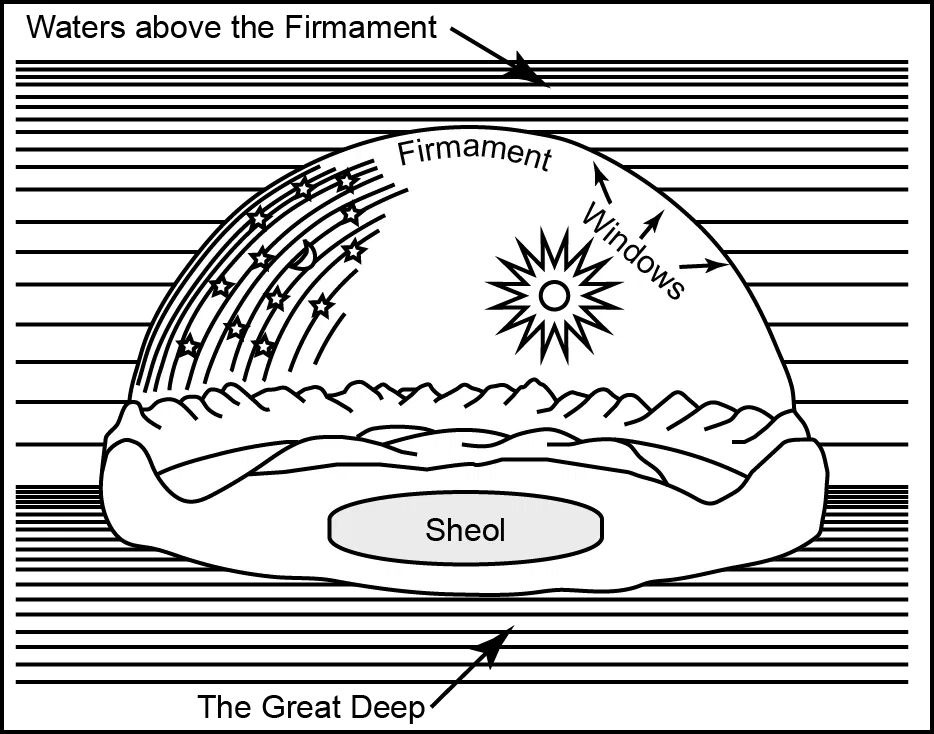
In Babylonian cosmology, as recorded in texts like the Enuma Elish, the god Marduk fashioned the sky from the body of the slain goddess Tiamat — a solid structure forged from the hardest metal, resting on a wall surrounding the earth. The Egyptians conceived of the heavens as an arched iron ceiling from which the stars hung by cables. The Greeks and Romans described the sky as a great vault of crystal or metal to which the fixed stars were attached. The Catholic Encyclopedia, in its 1909 entry on the firmament — published with the nihil obstat and imprimatur of the Archdiocese of New York — states plainly: “The notion that the sky was a vast solid dome seems to have been common among the ancient peoples whose ideas of cosmology have come down to us.” The entry concludes that “the Bible simply reflects the current cosmological ideas and language of the time.”
This is not a modern liberal interpretation imposed on the text. It is what Catholic scholarship recognized more than a century ago. The ancient Israelites, like their neighbors, appear to have understood the sky as a solid barrier holding back waters above. Several other Old Testament passages reinforce this picture. Job 37:18 asks whether the reader has “spread out the skies, hard as a cast metal mirror.” Ezekiel 1:22 describes a vision of something “like the expanse of the awesome crystal” spread over the heads of living creatures. The flood narrative in Genesis 7:11 speaks of “the windows of heaven” being opened — language that makes sense if the sky is understood as a solid structure with openings through which water can pour. Genesis 1:20 describes birds flying “across the face of the firmament of the heavens” — in front of it, not within it — which makes sense if the raqia is a solid surface and the birds fly in the air between it and the earth.
The weight of evidence — linguistic, comparative, and textual — strongly supports the conclusion that the original authors and audience of Genesis understood the raqia as a solid structure. The majority of biblical scholars across confessional lines agree on this point.
The Modern Firmament Movement
If this were purely an academic question about ancient cosmology, it would generate little controversy. But in recent years, a movement has emerged — primarily online — that takes the ancient understanding of raqia and makes a very different claim: that the solid dome is not merely what the ancient Israelites believed, but what is actually, physically true. This movement is closely intertwined with the flat earth community and presents the firmament as proof that modern astronomy, space exploration, and the spherical earth are all elaborate deceptions.
The argument typically runs as follows: The Bible is the Word of God. The Bible describes a solid dome over the earth. Therefore a solid dome exists over the earth. Any scientific evidence to the contrary is either fraudulent or misinterpreted. NASA, space agencies, and mainstream science are engaged in a conspiracy to hide the true structure of the world from humanity.
This argument has gained significant traction on social media platforms, where short videos citing biblical proof-texts can reach millions of viewers. The appeal is not difficult to understand. It offers a simple, Scripture-centered worldview in which the Bible is not merely a book of faith but a comprehensive physical description of reality, and in which the faithful remnant who believe it are vindicated against the deceptions of secular institutions. For Christians who already distrust mainstream culture or feel that their faith is under assault, the firmament narrative provides a framework in which fidelity to Scripture and rejection of modern science become the same act.
What the Catholic Church Actually Teaches
The Catholic Church has addressed the relationship between Scripture and natural science with remarkable consistency across more than a century of authoritative teaching. The principles are clear, and they bear directly on the firmament question.
Pope Leo XIII, in his 1893 encyclical Providentissimus Deus, established the framework that remains normative for Catholic biblical interpretation. He taught that the sacred writers “did not seek to penetrate the secrets of nature, but rather described and dealt with things in more or less figurative language, or in terms which were commonly used at the time.” Quoting Saint Augustine, he affirmed that the Holy Spirit, speaking through the biblical authors, “did not intend to teach men these things — that is to say, the essential nature of the things of the visible universe — things in no way profitable unto salvation.” The sacred writers, Leo XIII explained, following Saint Thomas Aquinas, “went by what sensibly appeared” — they described the world as it looked to them, using the language and concepts available to their culture.
This teaching does not diminish the authority or inspiration of Scripture. It clarifies what Scripture intends to teach. When Genesis describes the raqia, it is communicating theological truths about God’s sovereign ordering of creation — that God separated, structured, and gave order to the primordial chaos, that the heavens and the earth exist by His will and design. It is not providing an engineering diagram of the atmosphere. To demand that it do so is to ask of Scripture something Scripture does not claim for itself.
The Second Vatican Council’s Dei Verbum (1965) reaffirmed and developed these principles. It taught that interpreters must attend to “literary forms” and recognize that “truth is set forth and expressed differently in texts which are variously historical, prophetic, poetic, or of other forms of discourse.” The Catechism of the Catholic Church states that to interpret Scripture correctly, “the reader must be attentive to what the human authors truly wanted to affirm, and to what God wanted to reveal to us by their words” (CCC 109).
Saint Augustine, writing in the early fifth century — long before the modern scientific era — warned Christians against using Scripture to make scientific claims that would embarrass the faith. In De Genesi ad Litteram (The Literal Meaning of Genesis), he wrote that when a non-Christian hears a Christian “talking nonsense” about matters of natural science, “claiming that what he is saying is based on Scripture,” the result is that “they could hardly keep from laughing.” Augustine’s concern was not hypothetical. He understood that forcing Scripture to serve as a science textbook damages its credibility on the matters it actually addresses — the nature of God, the reality of sin, the hope of salvation.
Where the Solid Dome Argument Fails
The claim that a literal solid dome currently exists over the earth fails on two distinct grounds: scientific and theological. Both deserve examination.
The scientific case is straightforward. We have sent human beings beyond the atmosphere and brought them back. The Artemis II crew, just weeks ago, flew around the Moon at a distance of 252,756 miles from Earth, photographed the Earth and Moon, and returned safely. Thousands of satellites orbit the planet at various altitudes. Weather balloons ascend through the atmosphere without encountering a solid barrier. Telescopes observe galaxies billions of light-years away through an atmosphere that is gaseous, not solid. The atmospheric sciences have mapped the composition and behavior of the air above us with extraordinary precision. There is no solid dome. This is not a matter of interpretation or perspective. It is an observable, measurable, repeatedly verified fact.
The theological case is equally clear, and for a Catholic, it is the more important one. The claim that Genesis teaches the physical existence of a solid dome rests on a method of biblical interpretation that the Catholic Church has explicitly and repeatedly rejected. It treats Genesis as a scientific text. It ignores literary genre. It disregards the principles of Providentissimus Deus and Dei Verbum. It contradicts the interpretive wisdom of Augustine, Aquinas, and the entire Catholic exegetical tradition. And it elevates the cosmological assumptions of the ancient Near East — assumptions that the biblical authors shared with their pagan neighbors — to the status of divine revelation.
This last point is crucial. If the raqia is a divinely revealed physical fact, then so are the waters above the dome, the pillars of the earth, the windows of heaven, and every other element of ancient Near Eastern cosmology reflected in the biblical text. The firmament claim cannot be isolated from the broader cosmological picture in which it is embedded. And that broader picture — a flat earth covered by a solid dome, resting on pillars, surrounded by waters — is not a distinctively biblical cosmology. It is the common cosmology of the ancient world. The Bible uses this cosmological language because its human authors lived in that world. The theological truths those authors communicated — that God created, ordered, and sustains all things — transcend the cosmological framework in which they were expressed, just as the truth of the parable of the Good Samaritan does not depend on whether there was a specific man on a specific road.
Why This Question Matters to People
The firmament question deserves more than a dismissive answer because the people asking it are often motivated by something genuine and good: a desire to take Scripture seriously. In a culture that frequently treats the Bible as irrelevant, outdated, or merely symbolic, the instinct to defend the authority of God’s Word is not wrong. It is, in fact, deeply Catholic. The Church teaches that Scripture is inspired, inerrant in what it affirms for the sake of our salvation, and authoritative in faith and morals. A Christian who wants to honor the Bible is responding to a real and proper impulse.
The error is not in taking Scripture seriously. The error is in taking it on terms it does not set for itself. When we force Genesis into the role of a physics textbook, we do not honor it — we distort it. We ask it to answer questions it was never written to address, and in doing so, we risk missing the questions it does answer with unmatched authority: Who made the world? Is it good? Does it have purpose? Is there a God who orders and sustains all things? Genesis answers these questions with a resounding yes. Those answers do not depend on whether the raqia is solid or gaseous. They depend on whether God is real, and whether He is the author of all that exists.
There is also, for some, a deeper anxiety at work. If the Bible describes the sky in terms that do not match physical reality, does that mean the Bible is wrong? Does it undermine trust in Scripture? The Catholic answer is no — not because we ignore the difficulty, but because we understand what biblical inerrancy means. Scripture is without error in what it teaches. What Genesis teaches is that God created the heavens and the earth, that He imposed order on chaos, that He separated light from darkness and waters from waters. The cosmological language in which these truths are expressed belongs to the ancient world. The truths themselves belong to eternity.
Reading Genesis With Both Faith and Honesty
The Hebrew word raqia almost certainly carried connotations of solidity for the ancient Israelites who first heard and preserved the creation account. Biblical scholars across the spectrum — Catholic, Protestant, Jewish, and secular — agree on this with broad consensus. The ancient Israelites, like their Babylonian and Egyptian neighbors, understood the sky as a solid barrier holding back celestial waters. The Bible uses this language because its human authors lived within this understanding. This is not a scandal. It is how divine inspiration works: God speaks through human beings, in human languages, within human cultures, to communicate truths that transcend all of these.
What the Bible does not do — and what the Catholic Church has consistently taught it does not do — is provide a scientific description of the physical universe. Pope Leo XIII made this clear in 1893. The Second Vatican Council reaffirmed it in 1965. Saint Augustine warned against the opposite assumption in the fifth century. The entire Catholic intellectual tradition, from the Church Fathers through the medieval doctors to the Vatican Observatory, proceeds from the conviction that faith and reason illuminate each other, and that the truths of natural science and the truths of revelation cannot ultimately conflict because both come from the same God. As the Catechism states, “methodical research in all branches of knowledge, provided it is carried out in a truly scientific manner and does not override moral laws, can never conflict with the faith, because the things of the world and the things of faith derive from the same God” (CCC 159).
The firmament is not a test of faith. It is a lesson in how to read. When we read Genesis as the ancient, inspired, theologically profound text that it is — attending to its literary genre, its cultural context, its place within the whole of Scripture, and the interpretive tradition of the Church — we find not a rival to astronomy but a witness to the God who made the heavens that astronomy studies. The Psalmist who wrote “The heavens declare the glory of God; the firmament proclaims the work of his hands” (Psalm 19:1) was not making a claim about atmospheric physics. He was making a claim about God — a claim that remains as true when we look through a telescope as when he looked up at the ancient sky with his unaided eyes.
Disclaimer: Amen4Jesus is an independent Catholic-inspired resource written by lay authors. Content is intended to inform, encourage, and support your faith life, not to serve as authoritative doctrinal instruction, professional advice, or official Church teaching. For definitive guidance, consult the Catechism of the Catholic Church, your parish priest, or your local bishop. Opinions expressed in commentary articles are the authors' own. Content examining controversial theories is for educational purposes only and does not imply endorsement. Contact us at editor@amen4jesus.com