
What This Theory Claims
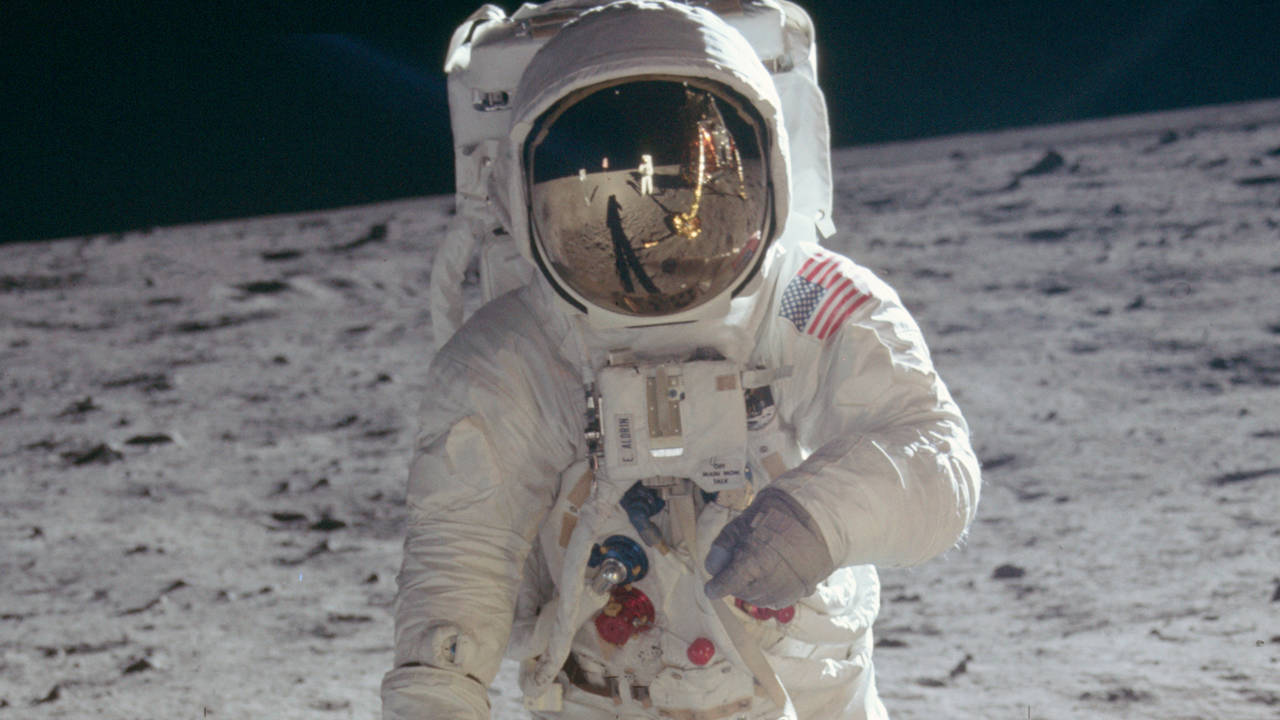
- The Apollo program (1969 to 1972) never landed humans on the Moon, and NASA filmed the missions on a secret soundstage, often alleged to be directed or assisted by Stanley Kubrick.
- The modern claim originated with Bill Kaysing, a former technical writer at Rocketdyne, whose 1976 self-published pamphlet We Never Went to the Moon: America’s Thirty Billion Dollar Swindle laid the foundation for nearly every subsequent argument.
- Proponents cite photographic anomalies such as the absence of stars in lunar sky photos, non-parallel shadows, a flag that appears to wave in a vacuum, and alleged crosshair discrepancies as physical proof of studio fabrication.
- The mainstream scientific community, including NASA, the European Space Agency, and every major astrophysics institution, considers the hoax claim to be demonstrably false, supported by independent verification from rival nations, retroreflector experiments, and 842 pounds of returned lunar samples.
- A 2001 Fox Television special, Conspiracy Theory: Did We Land on the Moon?, drew over fifteen million viewers and reignited public interest in the claim, while the April 2026 Artemis II lunar flyby has generated a fresh wave of “fake NASA” hashtags on social media.
- The Catholic Church holds no doctrinal position on the Apollo program, but its teaching that faith and reason cannot truly contradict one another (CCC 159) invites Catholics to examine physical evidence with honesty and intellectual humility.
Where the Claim Began
The modern moon-landing hoax narrative did not emerge during the Apollo missions themselves. Public skepticism was minimal in the years immediately following Apollo 11, and the global reaction to the July 1969 landing was overwhelmingly one of wonder. The seed was planted seven years later, when Bill Kaysing published his pamphlet. Kaysing had worked at Rocketdyne, the company that built the Saturn V’s F-1 engines, though he left the firm in 1963 and held no engineering degree. His pamphlet argued that NASA’s own internal reliability assessments showed a low probability of a successful lunar landing and that the agency therefore chose to stage the event rather than risk public failure during the Space Race.
Kaysing’s work circulated in fringe communities for two decades before finding a larger audience. The turning point came in February 2001, when Fox aired Conspiracy Theory: Did We Land on the Moon?, a prime-time special that featured Kaysing alongside fellow skeptics Bart Sibrel and Ralph René. The program reached over fifteen million American households in two separate broadcasts and introduced the photographic anomaly arguments to a mainstream television audience. Polls taken in subsequent years showed a measurable uptick in doubt, with roughly ten to eleven percent of Americans expressing some level of disbelief in the landings by the early 2020s.
The Photographic Arguments
The most frequently cited piece of alleged evidence is the absence of stars in photographs taken on the lunar surface. Proponents argue that if the astronauts were truly standing in the airless void of space, the sky behind them should be filled with brilliant stars. The explanation is straightforward and well understood by any photographer. The lunar surface in direct sunlight is extraordinarily bright. The astronauts’ cameras were set to short exposure times and small apertures to properly expose the sunlit landscape and their white spacesuits. At those settings, the relatively faint light of distant stars simply does not register on the film. The same effect can be reproduced on Earth by photographing a brightly lit parking lot at night; the overhead stars vanish from the image not because they are absent, but because the camera is not configured to capture them.
A second persistent argument involves shadows in the lunar photographs that appear to point in different directions rather than running perfectly parallel. Conspiracy theorists interpret this as proof of multiple artificial light sources on a studio set, where the Sun alone would produce only parallel shadows. In reality, the uneven and undulating terrain of the lunar surface causes shadows to diverge, converge, and shift in apparent angle depending on the slope and position of the objects casting them. This effect has been demonstrated in controlled terrestrial experiments and was famously tested on the television program MythBusters, which replicated the divergent shadow pattern using a single distant light source and varied ground elevation.
The waving flag is perhaps the most iconic objection. Video footage shows the American flag planted by Armstrong and Aldrin appearing to ripple as though caught in a breeze, which would be impossible in the vacuum of the Moon. NASA’s design solution was a horizontal telescoping rod sewn into the top hem of the flag to hold it extended, since a freely hanging flag on the Moon would simply droop lifelessly. The apparent rippling occurred only when the astronauts were handling the flagpole, twisting and pushing it into the regolith. In every frame where the flag is left untouched, it remains perfectly still. The absence of atmospheric damping actually makes the motion more noticeable, because on Earth a flag would quickly stop swaying once released, whereas the flag on the Moon continued to oscillate longer before friction at the pivot point brought it to rest.
Beyond the Photographs
Some proponents raise broader technical objections. One recurring claim is that the Van Allen radiation belts would have delivered a lethal dose to any astronaut passing through them. The Apollo trajectory was carefully plotted to pass through the thinnest regions of the belts, and the transit time was approximately thirty minutes in each direction. Dosimeter badges worn by the crew recorded total mission radiation doses in the range of 0.16 to 1.14 rads, well within safe limits and far below levels that would cause acute radiation sickness. These readings are consistent with the known particle density of the regions traversed and have been independently confirmed by subsequent unmanned missions that carried radiation-monitoring instruments along similar paths.
Another argument holds that the technology of the 1960s was simply too primitive to achieve a Moon landing. This objection underestimates both the scale and the intensity of the Apollo program. At its peak, the effort employed approximately 400,000 people across NASA and more than 20,000 industrial contractors and universities. The Saturn V rocket remains one of the most powerful machines ever built, and its engineering was validated by multiple uncrewed test flights before any astronaut boarded. The argument from technological incredulity is itself a form of reasoning from ignorance: the fact that the achievement was difficult does not mean it was impossible, and the detailed engineering records, mission transcripts, and telemetry data remain publicly available for inspection.
Independent Verification
Perhaps the strongest evidence against the hoax claim is the sheer number of independent parties that confirmed the Apollo missions in real time and in the decades that followed. The Soviet Union tracked every Apollo flight using its own deep-space monitoring network. The Soviets had the most powerful motive imaginable to expose a fraud. They were locked in a bitter geopolitical contest with the United States, and proving that America faked its greatest achievement would have been a propaganda victory of immeasurable value. They never made such a claim because their own instruments confirmed the trajectories, communications, and landing events.
Amateur radio operators around the world independently received transmissions from the Apollo spacecraft. Observatories in the United Kingdom, Australia, and Spain participated in tracking the missions. The Parkes Observatory in New South Wales received and relayed television signals from Apollo 11, an event documented extensively and depicted in the 2000 film The Dish.
In the years since Apollo, the evidence has only grown stronger. NASA’s Lunar Reconnaissance Orbiter, launched in 2009, photographed all six Apollo landing sites from orbit at resolutions as fine as 27 centimeters per pixel. The images clearly show the descent stages of the Lunar Modules, the tracks left by the astronauts’ boots, the paths of the lunar rovers, and the scientific instruments deployed on the surface. Japan’s Kaguya orbiter, India’s Chandrayaan-1, and China’s Chang’e missions have all returned data consistent with the Apollo record.
The retroreflector arrays placed on the lunar surface during Apollo 11, 14, and 15 remain in use to this day. Observatories in the United States, France, Italy, Germany, and Australia regularly fire laser pulses at these arrays and measure the return time to calculate the Earth-Moon distance with millimeter precision. This ongoing experiment, known as lunar laser ranging, is one of the most precise measurements in all of physics and could not function without physical hardware on the Moon.
The 842 pounds of lunar rock and soil returned by the Apollo missions have been studied by thousands of scientists across dozens of countries for more than five decades. The samples display characteristics that are impossible to replicate in a terrestrial laboratory: micrometeorite impact pits, solar-wind-implanted noble gases, unique mineral compositions including armalcolite (a mineral first identified in Moon rocks and named after Armstrong, Aldrin, and Collins), and radiometric ages clustering around 3.1 to 4.4 billion years. These samples match lunar meteorites found independently on Earth and compare favorably with material returned by the Soviet Union’s robotic Luna missions.
The Artemis II Revival
The conspiracy theory experienced a significant resurgence in April 2026 following NASA’s Artemis II mission, which carried four astronauts on a lunar flyby. Within hours of the mission broadcast, social media users began circulating clips they claimed showed green-screen artifacts, inconsistent lighting, and other signs of studio fabrication. Hashtags such as “fake space” and “fake NASA” trended across multiple platforms.
Fact-checking organizations including BBC Verify, AFP Fact Check, and Lifehacker quickly traced the alleged anomalies to television graphics overlays, compression artifacts in live video streams, and in some cases deliberately manipulated AI-generated images shared as though they were mission footage. The Artemis II spacecraft’s trajectory was independently tracked in real time by amateur radio operators, the European Space Agency, and the Japanese Aerospace Exploration Agency. The notion that every one of these parties simultaneously conspired to fake a lunar flyby strains credulity well past the breaking point.
The Scale of the Alleged Conspiracy
One of the most damaging problems for the hoax hypothesis is the sheer number of people who would need to remain silent. The Apollo program at its height involved roughly 400,000 workers across NASA and its contractor network, spanning facilities in Texas, Florida, Alabama, California, and numerous other states. Maintaining a perfect secret among that many individuals for over fifty years is without precedent in the history of intelligence operations. By comparison, the Manhattan Project employed approximately 130,000 people and began leaking information to the Soviet Union almost immediately through spies such as Klaus Fuchs and Theodore Hall. No Apollo insider has ever produced credible evidence of a hoax, despite the enormous financial incentive that would await anyone who could substantiate such a claim.
Why People Believe
Understanding the appeal of the moon-landing hoax theory requires more than simply cataloguing the evidence against it. Research published by the American Psychological Association and in the journal Frontiers in Psychology has identified several cognitive and social factors that predispose individuals toward conspiracy belief. These include a general distrust of institutional authority, a preference for intuitive rather than analytical thinking, a desire for certainty and clear moral narratives in a complex world, and a sense that ordinary citizens are excluded from the knowledge held by powerful elites.
The moon-landing hoax theory offers a strikingly simple story. It replaces the messy complexity of Cold War geopolitics, massive engineering challenges, and incremental scientific achievement with a tidy narrative of deception and hidden truth. Believing it can make a person feel intellectually empowered, as though they have seen through a veil that the majority cannot penetrate. That emotional reward is real, even when the factual foundation is not.
The rise of social media and video-sharing platforms has accelerated the spread of such claims. Algorithmic recommendation systems tend to surface increasingly extreme content to users who engage with conspiracy-related material, creating feedback loops that reinforce belief and insulate it from contrary evidence. The April 2026 Artemis II episode illustrates this dynamic vividly, as AI-generated images and out-of-context clips circulated far more rapidly than the careful fact-checks that followed.
A Catholic Perspective on Evidence and Truth
The Catholic Church has no doctrinal teaching about the Apollo program, and Catholics are free to assess the evidence on its merits. What the Church does teach, however, is directly relevant to how a person of faith should approach claims like these. The Catechism states that “methodical research in all branches of knowledge, provided it is carried out in a truly scientific manner and does not override moral laws, can never conflict with the faith, because the things of the world and the things of faith derive from the same God” (CCC 159). This principle, rooted in the thought of Saint Thomas Aquinas and reaffirmed by the First Vatican Council, places a positive obligation on Catholics to respect well-established scientific findings rather than retreating into unfounded suspicion.
Pope Leo XIII, in his 1893 encyclical Providentissimus Deus, warned against the temptation to invoke faith as a shield against inconvenient evidence, noting that “truth cannot contradict truth” and that apparent conflicts between science and Scripture arise from either faulty interpretation or incomplete data. The moon-landing hoax theory does not involve a tension between science and revelation. It involves a tension between verified physical evidence and a narrative of institutional deception. A Catholic committed to intellectual honesty has every reason to follow the evidence wherever it leads, and in this case the evidence leads to a clear and unambiguous conclusion.
Honest Inquiry and the Weight of Evidence
The Apollo moon-landing hoax theory does not survive serious examination. Every photographic anomaly cited by proponents has a well-understood explanation rooted in optics, lighting physics, and the behavior of materials in vacuum. Every technical objection regarding radiation, temperature, or computing power has been addressed by detailed engineering analysis and corroborated by independent measurements. The physical evidence, from retroreflector arrays still in daily use to hundreds of pounds of geologically unique lunar rock, is not merely suggestive but overwhelming. The confirmation provided by rival nations, independent observatories, and orbital photography leaves no reasonable room for doubt.
None of this means that asking questions about extraordinary achievements is wrong. Healthy skepticism is a virtue, and the willingness to examine bold claims carefully is precisely what good science demands. The difficulty arises when skepticism becomes selective, when a person demands impossible standards of proof from one source while accepting extraordinary claims from another on the basis of a blurry photograph or an anonymous social-media post. For Catholics, the call to pursue truth is not optional. It is woven into the very structure of faith. The same God who invites belief also gave human beings the capacity for reason, and the Church has consistently taught that those two gifts do not work against each other. The Apollo landings happened. The evidence is vast, public, and independently verified. Acknowledging that fact does not diminish wonder. If anything, the real story of human beings traveling a quarter of a million miles through the void to walk on another world is far more astonishing than any tale of a soundstage in the Nevada desert.
“The heavens declare the glory of God; the skies proclaim the work of his hands.” (Psalm 19:1)
Disclaimer: Amen4Jesus is an independent Catholic-inspired resource written by lay authors. Content is intended to inform, encourage, and support your faith life, not to serve as authoritative doctrinal instruction, professional advice, or official Church teaching. For definitive guidance, consult the Catechism of the Catholic Church, your parish priest, or your local bishop. Opinions expressed in commentary articles are the authors' own. Content examining controversial theories is for educational purposes only and does not imply endorsement. Contact us at editor@amen4jesus.com