
What This Theory Claims
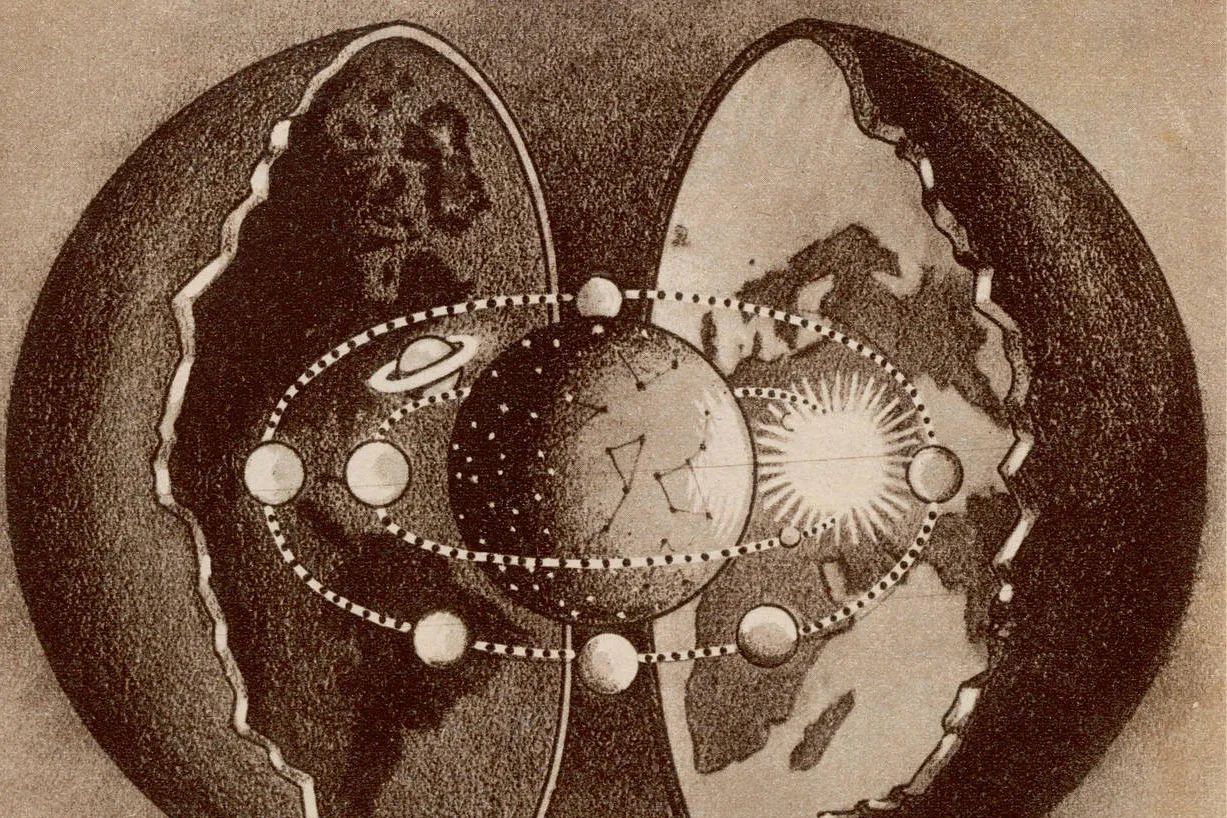
- The Hollow Earth theory proposes that our planet is not a solid sphere but a shell approximately 800 miles thick, with vast habitable spaces, polar openings, and possibly an interior sun.
- The idea was first proposed in a scientific context by the English astronomer Edmond Halley in 1692, who envisioned concentric inner shells to explain anomalous compass readings, and was later championed by American veteran John Cleves Symmes Jr. in 1818, who petitioned Congress for a polar expedition to find the entrance.
- Proponents cite alleged polar anomalies, a fabricated “secret diary” attributed to Admiral Richard E. Byrd, and ancient myths of subterranean kingdoms such as Agartha and Shambhala as supporting evidence.
- Mainstream geology, physics, and seismology reject the theory entirely, as the observed travel times of seismic waves, the measured average density of the Earth (5.515 g/cm3), Newton’s shell theorem, the Cavendish experiment, and the geodynamo model of Earth’s magnetic field all require a solid, layered interior.
- The Catholic Church holds no teaching on the shape of Earth’s interior, but affirms that scientific investigation conducted honestly cannot contradict faith (CCC 159) and that God is the Creator of all that exists, visible and invisible (CCC 325).
- The theory has enjoyed a rich afterlife in fiction, from Jules Verne’s 1864 Journey to the Center of the Earth to the 2021 film Godzilla vs. Kong, and continues to circulate in online conspiracy communities alongside flat-earth and secret-space-program narratives.
A Distinguished Pedigree
Unlike many conspiracy theories born on internet forums, the Hollow Earth idea descends from genuine scientific inquiry. Edmond Halley, the Royal Society astronomer whose name adorns the famous comet, presented a paper to the Philosophical Transactions in 1692 proposing that the Earth consists of an outer shell about 500 miles thick, two concentric inner shells, and a solid innermost core. Each shell possessed its own magnetic poles and rotated independently of the others, which Halley believed explained why compass needles drifted over time. He further speculated that luminous atmospheres separated the shells and that escaping inner gases produced the aurora borealis. For Halley, who assumed that all planets in the solar system were inhabited, the hollow interior was simply another domain in which a generous Creator might place living creatures.
Halley’s model was wrong, but it was not irrational by the standards of his era. Newton had recently published the Principia, and the data available on Earth’s density and internal structure were scarce. The hypothesis was an attempt to reconcile observed magnetic variation with the known laws of physics. It deserves to be understood in that context rather than ridiculed as the ramblings of a crank.
From Halley to Symmes
The idea evolved considerably in the following century. In 1818, Captain John Cleves Symmes Jr., a decorated veteran of the War of 1812 living in Ohio, issued a public circular declaring “the earth is hollow, and habitable within; containing a number of solid concentric spheres, one within the other, and that it is open at the poles 12 or 16 degrees.” He proposed openings roughly 1,400 miles across at the North and South Poles and solicited “one hundred brave men” for an expedition to prove his theory. Symmes lectured widely across the United States, attracted a devoted following, and even petitioned Congress to fund a polar voyage. A memorial to his ideas still stands in Hamilton, Ohio.
Symmes never wrote a book, but his acolytes did. James McBride published Symmes’ Theory of Concentric Spheres in 1826, and Jeremiah Reynolds carried the campaign forward, ultimately helping to inspire the United States Exploring Expedition of 1838 to 1842. By Symmes’s death in 1829, however, the scientific tide had already turned against him. Pierre Bouguer’s gravitational measurements on the Chimborazo volcano in Ecuador during the late 1730s had tentatively shown that the Earth was far too dense to be hollow. The Schiehallion experiment of 1774, conducted in Scotland by Nevil Maskelyne and calculated by mathematician Charles Hutton, produced a density estimate for the Earth of approximately 4,500 kilograms per cubic meter. Although that figure was about 18 percent below the modern value of 5,515 kilograms per cubic meter, it was already far too high for a planet with significant interior voids.
The Density Problem
This is the single most devastating objection to the Hollow Earth theory, and it can be stated simply. The average density of the Earth, as confirmed by the Cavendish experiment in 1798 and refined by modern measurements, is 5.515 grams per cubic centimeter. Typical crustal rocks, the granites and basalts we can pick up and weigh, have densities of only about 2.7 to 3.0 grams per cubic centimeter. Something deep inside the planet must be far denser than the rocks at the surface in order to produce the measured average.
That “something” is the core. Under the conditions of pressure and temperature expected at the center of a solid Earth, nickel-iron alloy reaches densities between 10 and 13 grams per cubic centimeter, which brings the overall average into agreement with observation. If the Earth were a hollow shell 800 miles thick, as the theory typically proposes, the average density would be drastically lower than what is measured. The planet would also have a weaker gravitational field than the one we observe and experience every moment of every day. There is no known material that could fill an 800-mile-thick shell and still produce the observed surface gravity while leaving the interior empty.
What Seismic Waves Reveal
Modern understanding of Earth’s interior does not rest on theory alone. It rests on direct observation, primarily through seismology. When an earthquake occurs, it generates two principal types of body waves. Primary waves (P-waves) are compressional waves that travel through both solids and liquids. Secondary waves (S-waves) are shear waves that can pass through solid material but cannot propagate through liquid.
Seismograph stations around the world record the arrival times of these waves after every significant earthquake. The patterns are unambiguous. P-waves arrive at stations on the far side of the planet, but with a noticeable delay at certain angular distances from the earthquake’s source, indicating that they have been refracted by a boundary between materials of different density. S-waves, by contrast, vanish entirely in a “shadow zone” on the far side of the planet, demonstrating that they have encountered a liquid layer through which they cannot travel. This is the liquid outer core, composed primarily of molten iron alloyed with lighter elements such as sulfur, oxygen, and silicon. Deeper still, P-waves speed up again, indicating a transition to a solid inner core.
A hollow Earth would produce an entirely different pattern of seismic wave arrivals. Waves would reflect off the inner surface of the shell, producing characteristic echoes that seismologists have never detected. The travel times across the planet would be dramatically shorter than what is observed. In short, every earthquake ever recorded provides fresh evidence that the Earth is not hollow. The data set is enormous, spanning over a century of continuous global monitoring, and it is consistent without exception.
The Geodynamo and the Magnetic Field
Earth possesses a strong magnetic field that shields the surface from solar radiation and cosmic rays. The mainstream explanation for this field is the geodynamo model, in which convective circulation of electrically conductive liquid iron in the outer core generates and sustains a self-reinforcing magnetic field. This model requires two things that the Hollow Earth theory cannot provide: a large volume of liquid metal capable of convective flow, and a solid inner core whose slow cooling drives the convection.
A hollow planet would lack the liquid iron outer core entirely. Without it, there is no mechanism to generate the observed magnetic field. Hollow Earth proponents have never offered a credible alternative explanation for the field’s existence, its measured strength, its periodic reversals recorded in the magnetization of seafloor basalts, or its slow secular variation that Halley himself was trying to explain.
Newton’s Shell Theorem
The physics of gravity within a hollow sphere was worked out by Isaac Newton himself. The shell theorem, published in the Principia in 1687, demonstrates that a uniform spherical shell of mass exerts zero net gravitational force on any object located anywhere inside it. The gravitational pulls from every part of the shell cancel out perfectly. This means that if the Earth were hollow, anyone standing on the inner surface would experience no gravitational pull toward that surface. Objects would not fall. People would not stand. Water would not flow. An inner civilization could not exist in any form recognizable to human life, because there would be no “down” to orient it. Proponents sometimes invoke centrifugal force from the planet’s rotation as a substitute, but the centrifugal acceleration at the inner surface of a shell rotating once every 24 hours is far too weak to mimic normal gravity, and it would push objects toward the equator of the interior rather than uniformly toward the shell.
The Admiral Byrd Legend
No discussion of the Hollow Earth theory is complete without addressing Admiral Richard E. Byrd, whose name is invoked more frequently than any other in support of the claim. Byrd was a genuine American hero, a pioneering aviator and polar explorer who led multiple expeditions to both the Arctic and the Antarctic. According to Hollow Earth believers, Byrd flew through a polar opening during a 1947 expedition and encountered a lush green land inhabited by an advanced civilization. This account is attributed to a “secret diary” that allegedly surfaced after Byrd’s death in 1957.
The problems with this narrative are severe. No authenticated version of the diary exists in any archive, including the extensive Byrd collection at the Ohio State University Byrd Polar and Climate Research Center. The text that circulates online contains stylistic inconsistencies and anachronisms that scholars have identified as evidence of forgery. Byrd himself never made any public statement about a hollow Earth during his lifetime, and his published accounts of his expeditions describe ice, snow, and extreme cold in terms entirely consistent with what we know about polar geography. Reuters has fact-checked photographs allegedly from Byrd’s expeditions that were shared as evidence of the hollow interior and found them to be generated by artificial intelligence. The Byrd legend is a posthumous fabrication attached to a real man’s name without his consent.
Agartha, Shambhala, and the Mythological Dimension
The Hollow Earth theory draws much of its emotional power from a deep well of global mythology. Cultures on every inhabited continent have told stories of subterranean realms. The Greeks described caverns leading to the underworld at locations across the Mediterranean. Hindu mythology speaks of Patala, a subterranean domain. Tibetan Buddhist tradition includes the legend of Shambhala, a hidden city of wisdom said to exist within the Earth. The Hopi people of the American Southwest believe in a Sipapu entrance in the Grand Canyon leading to an underworld. Celtic legends describe passages into the realm of the Tuatha De Danann beneath the hills of Ireland. Dante Alighieri structured his Inferno around a journey through the hollow interior of the planet.
In modern conspiracy circles, these diverse traditions have been synthesized into the legend of Agartha, a kingdom supposedly located at the center of the Earth, accessible through polar openings or secret tunnels in the Himalayas, the Andes, or other remote mountain ranges. Ferdynand Ossendowski described hearing of this kingdom from Buddhists during his travels through Mongolia, publishing his account in Beasts, Men and Gods in 1922. Raymond Bernard’s 1964 book The Hollow Earth wove these threads together with UFO lore, claiming that flying saucers originated from the interior.
These myths are fascinating as cultural artifacts. They reflect a universal human intuition that the world contains hidden depths and that wisdom might be found by going inward. A Catholic can appreciate the symbolic richness of such stories without confusing symbol with geology. Dante’s hollow Earth is a theological allegory, not a scientific claim, and the Hopi Sipapu is a sacred narrative about origins, not a geographic coordinate.
The Fiction That Keeps the Idea Alive
It is worth noting how powerfully fiction has sustained the Hollow Earth concept. Jules Verne’s 1864 novel Journey to the Center of the Earth imagined explorers descending through an Icelandic volcano into a vast underground ocean teeming with prehistoric life. Edgar Rice Burroughs created Pellucidar, a prehistoric inner world illuminated by a small interior sun, in a series of adventure novels beginning with At the Earth’s Core in 1914. More recently, the 2021 film Godzilla vs. Kong and its sequels have made a spectacular Hollow Earth a central plot element, introducing the concept to millions of viewers who might never encounter the 1692 paper of Edmond Halley.
These stories are delightful. They are also clearly labeled as fiction. The difficulty arises when the emotional residue of compelling stories blurs into belief, and when the distinction between “what makes a good novel” and “what the evidence shows” is quietly erased. A theory can be wonderful material for adventure fiction and simultaneously be ruled out by physics. Both of those things can be true at once.
Why the Theory Persists
Given the weight of evidence against it, why does the Hollow Earth theory continue to attract believers? The psychological research on conspiracy thinking offers several explanations. Distrust of institutional authority leads some people to assume that any claim made by mainstream science is potentially a cover story. The sheer scale of what is being asserted (that NASA, every geological survey, every university physics department, and every seismological station on Earth are either wrong or complicit) can paradoxically make the theory more appealing, because it offers the believer a sense of privileged knowledge that separates them from the uninformed majority.
There is also a spiritual dimension to the appeal. The idea that the Earth harbors a hidden paradise, a place of beauty and wisdom beneath the harsh surface, resonates with deep human longings for a better world. It echoes the Garden of Eden, the Promised Land, the kingdom of heaven. For some believers, the Hollow Earth is less a geological claim than a spiritual metaphor that has hardened into literal conviction. Understanding this helps explain why simply presenting evidence is often insufficient to change minds. The theory meets needs that geology alone does not address.
A Catholic View of the Earth Beneath Our Feet
The Catholic Church has never issued a doctrinal statement about the interior structure of the Earth. It is not a matter of faith or morals, and Catholics are free to follow the evidence wherever it leads. What the Church does teach, and teaches clearly, is that God is the Creator of all things visible and invisible (CCC 325), that the created world reflects the wisdom and goodness of its Maker (CCC 295, 339), and that scientific inquiry pursued honestly is a legitimate path to truth that cannot ultimately conflict with the truths of revelation (CCC 159).
Pope Leo XIII, in Providentissimus Deus, insisted that “truth cannot contradict truth” and that apparent conflicts between science and faith arise from faulty interpretation on one side or the other. The Second Vatican Council’s Gaudium et Spes affirmed that “methodical research in all branches of knowledge, provided it is carried out in a truly scientific manner and does not override moral laws, can never conflict with the faith.” These principles do not tell a Catholic what to think about seismic waves, but they do tell a Catholic how to think: with honesty, humility, and a willingness to accept what the evidence demonstrates.
The evidence demonstrates, with a certainty that science rarely achieves, that the Earth is not hollow. Its interior is a layered structure of crust, mantle, liquid outer core, and solid inner core, mapped in extraordinary detail by over a century of seismological observation and confirmed by gravitational measurement, geodesy, mineral physics, and the ongoing operation of the geodynamo. A Catholic who accepts this conclusion is not betraying faith. A Catholic who accepts this conclusion is exercising the very faculties of reason that the Creator bestowed.
The Wonder That Remains
The Hollow Earth theory is not a scientific possibility. It was a reasonable conjecture in the late seventeenth century, when Edmond Halley worked with incomplete data and a genuine desire to explain what he observed. It was already untenable by the late eighteenth century, when Bouguer, Hutton, and Cavendish measured the density of the planet. It is flatly contradicted by every branch of modern Earth science. The “secret diary” of Admiral Byrd is a forgery. The polar openings do not appear in any satellite image, any aerial survey, or any polar expedition record. Newton’s own shell theorem guarantees that life on the inner surface of a hollow sphere would be physically impossible.
None of this means that the Earth’s interior is boring. The reality is, if anything, more astonishing than the myth. Beneath our feet lies a liquid ocean of molten iron larger than the planet Mars, churning in slow convective currents that generate the magnetic shield protecting all life on the surface. At the very center sits a solid iron crystal roughly the size of the Moon, under pressures exceeding three million atmospheres, at temperatures comparable to the surface of the Sun. The mantle between core and crust creeps in vast convective cycles that drive the continents across the surface over hundreds of millions of years, building mountains and opening oceans. This is not a hidden paradise, but it is a hidden marvel, and it is real. For the person of faith, the true interior of the Earth is not less wondrous than the imagined one. It is more wondrous, because it is the work not of legend but of the God who holds all things in being.
“The earth is the Lord’s, and everything in it, the world, and all who live in it; for he founded it on the seas and established it on the waters.” (Psalm 24:1-2)
Disclaimer: Amen4Jesus is an independent Catholic-inspired resource written by lay authors. Content is intended to inform, encourage, and support your faith life, not to serve as authoritative doctrinal instruction, professional advice, or official Church teaching. For definitive guidance, consult the Catechism of the Catholic Church, your parish priest, or your local bishop. Opinions expressed in commentary articles are the authors' own. Content examining controversial theories is for educational purposes only and does not imply endorsement. Contact us at editor@amen4jesus.com